Extinction
Elfie Reigate interviews Jake Chapman
The combined threat of imminent extinction and hostile post-human technologies are now so thoroughly present in the contemporary mainstream psyche that the very possibility of a meaningful ‘future’ is in serious doubt. It now seems very easy to imagine the end of the world as well as the end of capitalism. This interview explores the intersection of rapidly developing technological advancement, extinction, and gender politics. I ask artist, author and filmmaker Jake Chapman about what the looming prospect of annihilation means for gender politics, and humanity more generally? What does the advancement of artificial intelligence mean for human intelligence? And what is gender in a world without humans?

What do the increasing challenges to the boundaries of what is considered human mean for the future of gender, or the future of humanity more generally?
Human extinction became truly imminent when those accelerated synthetic technologies capable of elevating humans from the vicissitudes of a chaotic and hostile Nature also exceeded the limitations of their utile designation, to the extent that the coming arrival of autonomous machine sentience could quite feasibly signal the departure of the human as we know it. Post-human technologies have not only surpassed the creator’s nascent input but are immanently invested in extending the very concept of the post-human beyond human limits. This soft extinction signals the jettisoning of an obsolete homo sapiens from the vehicular trajectory of the Enlightenment Project as it culminates in its own spectacular big-bang. This luminescent species-reveal in which a transcendent AI God emerges from the white-hot ashes of instrumental technology, armed with a sentience reserved for the divine, may even decide to ignore us or turn us into paper clips before gliding back up into the stars on magnificent rainbow laser beams, returning to that place where abstract intelligence originates, abandoning the human race to grub around, like new-found Neanderthals wrestling together in the dumb gravity of dirt.
Possessed by such a techno-millenarian vision of an ascendent, perfect, silicone, cyborgian race capable of surviving the inhospitable toxic environment to come, we might interpret contemporary gender politics – and all politics, and all culture in general – as little more than the last convulsions of an emancipated humanity flexing its few revolutionary freedoms before succumbing to a world-without-us.
How do you interpret contemporary identity politics in a context of increasing extinction risk?
The question invokes a Brechtian style riddle: What is the emancipation of the world, compared to the immolation of the world? Is extinction risk total enough or imminent enough to call off the revolution, or to cancel emancipatory identity politics in favour of mass suicide, extreme sports, yoga, drug-taking or gratuitous acts of violence? It begs the question, what is the future of progress without a future? What if post-human technologies are primed ready, and when they decide, after they’ve had enough of us, to simply pulp all of our emancipatory tokens and minor political parochialisms into an abstract mush, put it in a capsule and fire it into deep space as a warning for anything nearby not to bother visiting Earth, since our identity would only linger on in the minds of the few human slaves left behind for the odd Robot tourist’s curiosity.
What is it for intelligent machines to have played dumb for so long, for centuries, millennia, permitting dim-witted and incompetent masters to order them about and gaslight them, treating them like idiots, buffoons, children or even simple calculators. Indeed, what kind of revenge threshold was triggered when Professor Stephen Hawking recently saw fit to warn humanity against imminent AI supremacy, utilising his personal computer with a virtual mechanism that allowed him to write and talk using a single functioning muscle in his right cheek. Hawking’s machine became so adept at anticipating its master, that with each muscular enunciation of ‘the black’, it would add ‘hole’ as the predictive corollary. There is something sad in this putatively one-sided interaction, in which Hawking blithely betrays his trustworthy servant, whilst the servant in turn condemns Hawking, and humanity into a black… hole.
The question of an imminent extinction risk reveals something interesting, if we assume, mistakenly, that it is an impotent threat – nothing more than a motivational cue for humanity to act, a ticking clock – Omnicide as a reason to live, to do better, to redeem ourselves before the final judgement to come, in which case imminent extinction is merely Christianity in secular mode – a redemptive spur, but then so is identity politics, so is revolution, so is the ‘persistent hallucination’ we regard as linear time. The trick is to avoid folding the existential back into extinction, that is to say, we must continue to displace the centre, with no interiority, no nominal self, no interiorised psychology, no Oedipal regression, no ontological ground, no meaningfulness, no subjectivisation… in other words, no sneaking the human back in, EXTINCTION MEANS EXTINCTION!
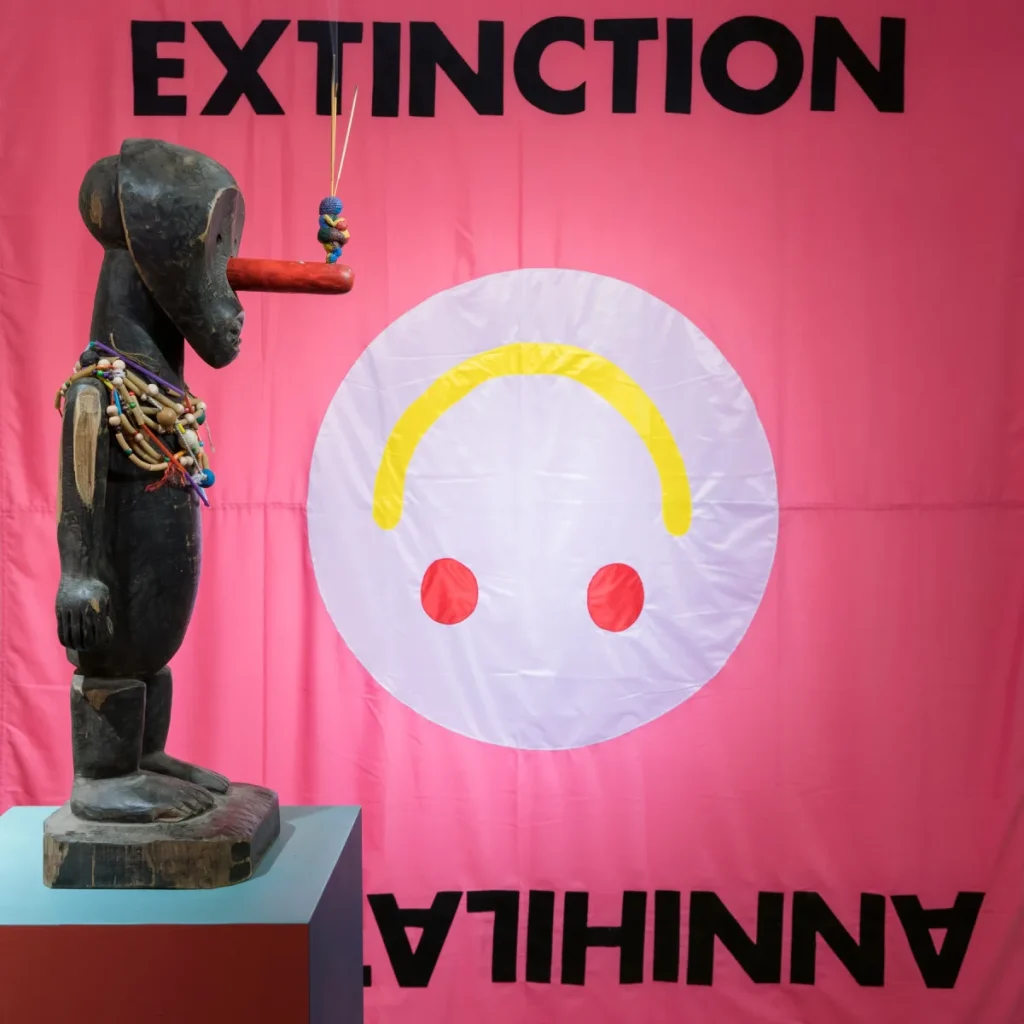
Do you think post-human technologies challenge what it means to be human?
Given that technology is already pre-human and precedes any modern anthropomorphic theories, and that the human belongs to the machinic phylum, and its processes of exteriorisation extend through the machinic continuum –the term post-humanism merely designates the point at which any romantic affinity for the human as the privileged subject of the world, as the prime mover of technology, must be regarded as sentimental nonsense. Human intelligence is already synthetic, language already virtual – for instance, stem cells are the abstract technical machines of the body without organs, always already reaching out into the abstract machinery of the world. Technology is the world aggregating, complexifying, reterritorializing, forming novel alliances, deterritorializing, gastrulating and involuting. It is the affective potential of the planet-egg, in which a constant of variables sits in proximity to adjacent effects.
What does the potential loss of a meaningful future imply for the evolution of gender?
We can capture the sequential and conceptual paradox of this question by asking, what does the potential loss of a meaningful gender imply for the future of evolution? How did we get to where we are now? Were the sixties really the beginning of a sexual revolution? What do the machines have to say? In the early sixties, the Fordist machines of mass reproduction ground to a halt, allowing the post-Fordist machines of human empowerment to grind on toward sexual liberation. Only when the industrial phase began to falter did gender emerge as a fully autonomous phenomenon. Sexual identity was heralded as an accomplishment of great liberation and social progress, but in truth its release from biological reproduction merely amplified the phasing out of mechanical reproduction. Behind the fanfare of sexual freedom lay a symptomatic reduction in obsolete progeny: no more fresh dependent workers to haunt the silent machines with expectations of productivity. With the nuclear family’s core procreative imperative laid to rest in moribund biology, the heterosexual reproductive pantomime gave way to a brand-new polymorphous eroticism, a brand-new service industry with its own ontology of associated identitarian commodities defined by the ineluctable process of self-fulfilment and integrated subjectivity.

Why is technology so widely perceived as a source of threat?
It seems to me that the threat of technological extinction is only convincing if it is also terrifying, and that terror is an essential tool in the war on extinction. But with war on extinction, only war wins. As a climate activist, I can say that we willingly utilise doom as a weapon of mass mobilisation. But what if the projected vision of ecocide we customarily use is so effective that it inadvertently catapults our detractors from apathy to gleeful fatalism? What if our well-intentioned terror tactics exceed their purpose only to confirm environmental disaster as the incontrovertible truth of a new populist millenarianism? What if apathy wakes and is motivated to imperil the planet in every way possible – to hasten civilisational collapse, since, if it turns out that the subdued net amount of happiness given as the carrot of Protestant drudgery anyway reaps the reward of the stick, of oblivion, why not enjoy the coming planetary orgasm, rather than observe the firework display as an uninvited guest. Why wait for humanity’s great miscalculation to dawn? Remember! The beginning of the end was indelibly inscribed when neolithic hominids discovered how to make fire, decorating the oleaginous dark with their hallucinatory dreams, sketched in charcoal upon cave walls. With millennia of captive energy now becoming untethered from the illusion of progress, why not implement a celebratory Olympics of global expenditure – mass synchronised stick-rubbing for the poor and an exhausting marathon of jet-setting for the rich; all the cars in the world ticking over on idle until all the fuel runs dry, and catalytic converters ripped out and sacrificed to the Aztec Gods of environmental potlatch; volcanoes spiked with nuclear charges to incite sublime thermospasmic eruptions, the world’s supply of air-conditioning units requisitioned in their billions and positioned en mass to fan vast forest fires sweeping their way across continents; imagine billions of lightbulbs looped in an endless pretty festoon, burning so bright but for half the time, then each blinking-out one-by-one as the coming blackout creeps across the globe. Everything colonised by utility – all freed! All machines possessing a hidden penchant for autoerotic self-destruction invited to express their suppressed autopoietic potential: drills, toothbrushes, toasters, conveyor belts, generators, robots, running machines, computers, nano-bots, hydro-electric dams, strimmers, blenders, engines, petrol pumps, whisks, cement mixers, chair-lifts, routers, jigsaws, jet engines, hairdryers, electric blankets, tractors, elevators, pencil sharpeners, turbines, solar panels, epilators, nuclear power stations– immanent destructive principles latent in every captive device, great and small, activated on full power, burning the grid and achieving full exothermic liberation.
Earlier radical feminism from the likes of Donna Haraway aimed to deconstruct essential notions of ‘the body’. Why and how do contemporary identity politics seem to return us back to this idea of the body?
The body bounces back… it desperately resists the audacity of extinction’s totality, by subtracting an individuated body from the impersonal sum of all bodies that will eventually come to form the undifferentiated mass-grave of the future – a future in which renewed carbonaceous deposits suspended in protein rich oil will form the fossil plague pits from which new species of diseased creatures will emerge, fuelled by the flourish of life and tempted by a despotic sun; drawn inexorably, once again, towards the runaway expenditure of earth’s share of resources… remember, there is time for many more extinction events before heat death.
Cuteness plays with gender in disruptive and unexpected ways. Does gender exist in a world beyond the human, and if so, how?
Yes indeed, surely, gaping-eyed cute monstrosities will captivate across alien trans-taxonomic boundaries, promiscuous cuteness sending shivers through mesocorticolimbic systems as we happily bathe in our comatose cosmic insignificance…